A novel, 1768
A Sentimental Journey Through France and Italy
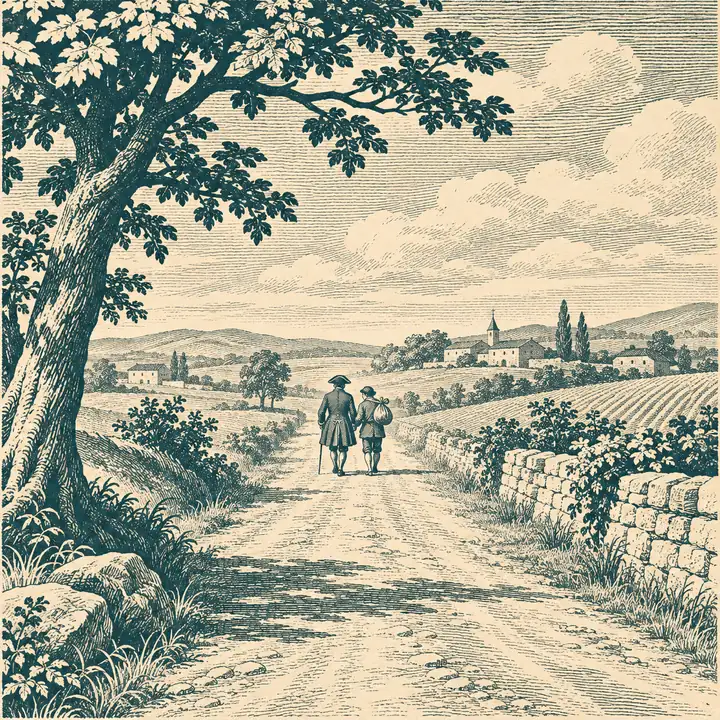
How it begins
—Et le bon Dieu vous bénisse encore, said the old soldier, the dwarf, &c. The pauvre honteux could say nothing;—he pull’d out a little handkerchief, and wiped his face as he turned away—and I thought he thanked me more than them all.
Section 1Keep reading →
Summary
Spoiler-free
Yorick travels through France toward Italy with his servant La Fleur, seeking human connection while contending with impatience, attraction, social hypocrisy, and the threat of imprisonment. His journey develops through encounters that test his sympathy rather than through a single sustained conflict.
Full summary
Spoilers
Yorick travels through France toward Italy with his servant La Fleur, seeking human connection while contending with impatience, attraction, social hypocrisy, and the threat of imprisonment. His journey develops through encounters that test his sympathy rather than through a single sustained conflict.
After La Fleur’s horse throws him near a dead ass, Yorick hears the animal’s owner mourning and wishes people loved one another as deeply. Yet he soon loses his temper with the postilion for driving too fast. At Amiens, Madame de L— gives him a letter to deliver in Paris and invites him to Brussels. His attraction to her troubles his attachment to Eliza; neither relationship reaches a resolution in these chapters.
In Paris, police attention makes Yorick fear confinement in the Bastile. He initially persuades himself that imprisonment would be tolerable, but a caged starling’s repeated cry destroys that consolation. Unable to release the bird, he imagines a prisoner enduring decades in a dungeon and weeps. This is the emotional turning point: an immediate encounter overturns his comfortable reasoning. He sets off for Versailles to seek the Duc de Choiseul’s protection, although he despises the servility of his rehearsed appeals. The outcome of that appeal is not given. La Fleur buys the starling for him, and Yorick recounts its later passage through numerous owners in England.
Other encounters expose the uncertainty of appearances and Yorick’s own shifting feelings. He cannot discover what a beggar whispers to women to obtain money. A hotelkeeper condemns him for entertaining a young woman in his bedroom, then offers to send him a lace seller. Yorick intends to expose this hypocrisy but relinquishes his resentment when faced with the seller’s patience.
Near Moulines, Yorick sits with the grieving Maria and her dog Sylvio, sharing her tears. She tells him of an earlier visitor and her travels in Italy. He comforts her and accompanies her to Moulines, then takes leave; her grief receives no final resolution. Later, a rural family welcomes him to supper. Watching its children and grandchildren dance to the old man’s music, he finds religious feeling in their happiness.
The journey ends before Yorick reaches Turin. A blocked road and bad weather force him to stop at an inn in Savoy, where he shares the only bedroom with a lady and her maid under agreed rules of conduct. He and the lady dispute whether an exclamation violates their agreement. When the maid comes between the beds, Yorick stretches out his hand and catches hold of her. The narrative stops without identifying where he touches her or describing anyone’s response. Yorick, the lady, and the maid receive no further conclusion; La Fleur’s subsequent fate is also unstated.
The ending
Bad weather and a blocked road leave Yorick sharing an inn bedroom in Savoy with a lady and her maid under agreed rules of conduct. After he disputes an exclamation with the lady, the maid comes between their beds. Yorick reaches out and catches hold of her, and the narrative ends without saying where he touches her or what happens next.
About the book
More from Read in an evening
- Black Nick, the hermit of the hillsDuring the American Revolution, Captain Adrian Schuyler carries a request for General Stark to join General Schuyler at Bemis’ Heights.
- Daddy-Long-LegsJerusha Abbott grows up in the John Grier Home, an orphanage, and longs for life beyond it.
- A Study in ScarletDr. John Watson returns to England after wounds and fever end his army service in Afghanistan.
- At the Sign of the SwordEdmond Valentin, a Belgian lawyer and soldier, and Aimee de Neuville love each other despite her father's opposition.



Text from Project Gutenberg.