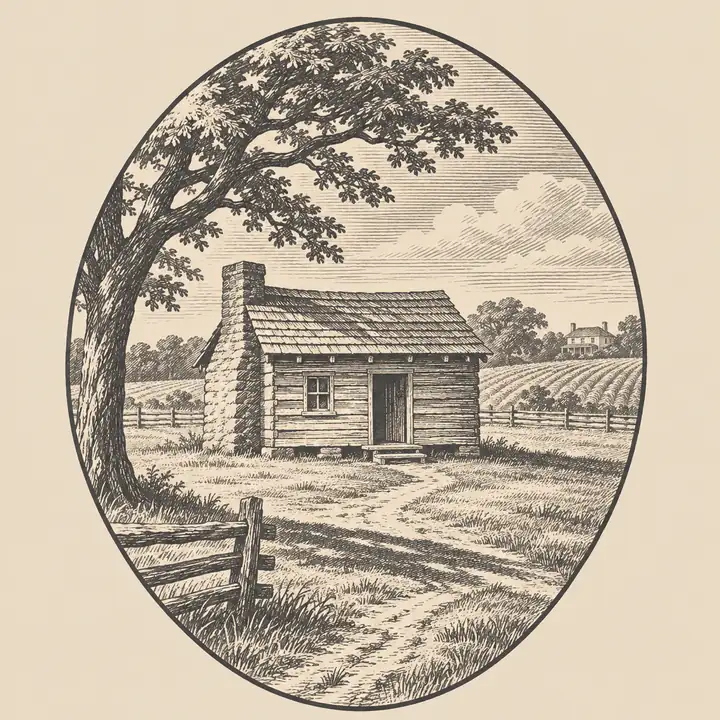
How it begins
My life had its beginning in the midst of the most miserable, desolate, and discouraging surroundings. This was so, however, not because my owners were especially cruel, for they were not, as compared with many others.
Chapter 1: A Slave Among SlavesKeep reading →
Summary
Spoiler-free
Born enslaved on a Virginia plantation, Booker T. Washington seeks an education and a way to help other Black Americans achieve lasting independence. Emancipation frees his family but leaves them facing poverty and uncertainty. They move to West Virginia, where Washington works while pursuing schooling despite racial barriers and limited resources.
Full summary
Spoilers
Born enslaved on a Virginia plantation, Booker T. Washington seeks an education and a way to help other Black Americans achieve lasting independence. Emancipation frees his family but leaves them facing poverty and uncertainty. They move to West Virginia, where Washington works while pursuing schooling despite racial barriers and limited resources.
After hearing about Hampton Institute, Washington resolves to attend. Employment with Viola Ruffner teaches him cleanliness, honesty, and careful work. At Hampton, General Armstrong and the teachers strengthen his conviction that education should combine academic study, practical skills, and service to others. Financial hardship and the racial violence he witnesses reinforce his sense of the obstacles facing freed people. He chooses educational work over a political career and returns to Hampton to lead a night school for students who must work during the day.
Armstrong recommends Washington to lead a new school in Tuskegee, Alabama. Arriving without an equipped school building, Washington surveys the surrounding poverty and inadequate teaching before opening classes. With support from George W. Campbell, Lewis Adams, and Olivia Davidson, he acquires farmland and develops a school where students study, farm, learn trades, make bricks, and construct their own buildings. Repeated failures, shortages, and debts threaten the enterprise, but student labor, local credit, small gifts from poor supporters, and Northern fundraising sustain it. Armstrong helps Washington reach donors, and Tuskegee steadily expands.
Washington also suffers personal loss: his first wife, Fannie N. Smith, dies, leaving their daughter Portia. He later marries Olivia Davidson, his colleague in building Tuskegee. His account presents family life, gardening, and raising animals as sources of rest amid increasing public responsibilities. His children receive both education and practical training, while his wife participates in women's clubs.
The public climax comes with Washington's Atlanta Exposition address. Before a crowded audience, he urges Black and white Southerners to cooperate through work and business, presenting industrial education and economic advancement as foundations for racial progress. He also supports voting rights and equal application of educational or property qualifications. The enthusiastic reception makes him a nationally prominent spokesman and greatly increases demands on his time.
The closing chapters trace the recognition that follows. Washington returns as an honored guest to the West Virginia community where he once struggled in poverty and receives further public welcomes. Armstrong visits Tuskegee despite disability, renewing Washington's commitment to his mentor's work. Washington receives an invitation to accept an honorary degree from Harvard and continues advocating justice while expressing confidence in Black Americans' future. His children remain engaged in education and practical preparation; the account supplies no later individual outcome for them. It ends in Richmond, where Washington, who once slept beneath a sidewalk there, now addresses Black and white citizens and public officials as an honored guest.
The ending
Washington receives growing public recognition, including an invitation to accept an honorary degree from Harvard, while continuing his educational work and advocacy for Black Americans. The autobiography ends in Richmond: once so poor that he slept beneath a sidewalk there, he now returns as an honored guest to address Black and white citizens and public officials.
About the book
Contents
- Chapter 1: A Slave Among Slaves
- Chapter 2: Boyhood Days
- Chapter 3: The Struggle for an Education
- Chapter 4: Helping Others
- Chapter 5: The Reconstruction Period
- Chapter 6: Black Race and Red Race
- Chapter 7: Early Days at Tuskegee
- Chapter 8: Teaching School in a Stable and a Hen-House
- Chapter 9: Anxious Days and Sleepless Nights
- Chapter 10: A Harder Task than Making Bricks without Straw
- Chapter 11: Making Their Beds before They Could Lie on Them
- Chapter 12: Raising Money
- Chapter 13: Two Thousand Miles for a Five-Minute Speech
- Chapter 14: The Atlanta Exposition Address
- Chapter 15: The Secret of Success in Public Speaking
- Chapter 16: Europe
- Chapter 17: Last Words
More from Start here
- FrankensteinRobert Walton sails toward the North Pole seeking discovery and glory but longs for a sympathetic friend.
- DraculaJonathan Harker travels to Transylvania to help Count Dracula buy property in England.
- EmmaEmma Woodhouse, wealthy, clever, and unmarried, lives with her anxious father at Hartfield in Highbury.
- Wuthering HeightsHeathcliff, an orphan brought home by Mr. Earnshaw, grows up devoted to Earnshaw’s daughter Catherine and persecuted by her brother Hindley.



Text from Project Gutenberg.