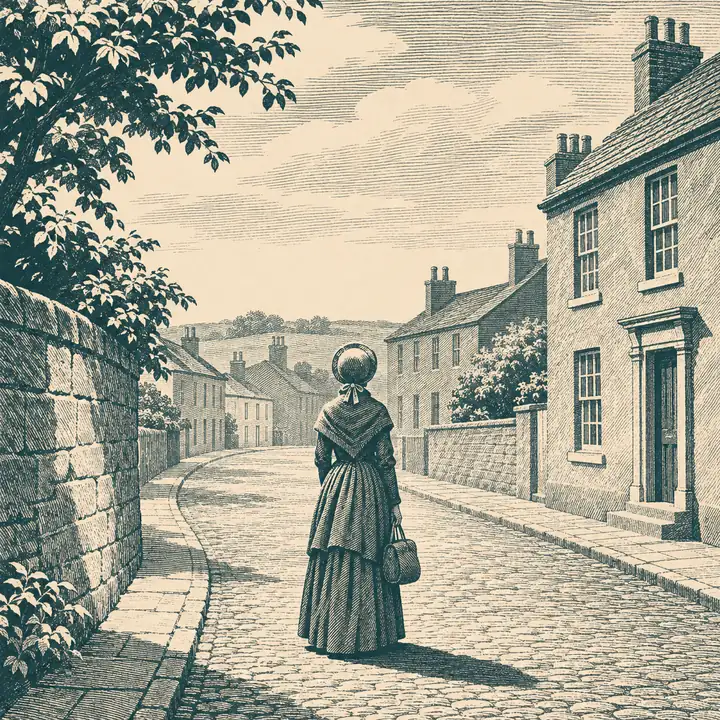
How it begins
My godmother lived in a handsome house in the clean and ancient town of Bretton. Her husband’s family had been residents there for generations, and bore, indeed, the name of their birthplace—Bretton of Bretton: whether by coincidence, or because some remote ancestor had been a personage of sufficient importance to leave his name to his neighbourhood, I know not.
Chapter 1: BrettonKeep reading →
Summary
Spoiler-free
Lucy Snowe, an Englishwoman without money or close family support, seeks a livelihood and a place where she can belong. After her employer, Miss Marchmont, dies, Lucy travels alone to Villette in Labassecour. Madame Beck hires her to care for her children, then makes her an English teacher. Lucy establishes herself through hard work, but suffers from loneliness beneath her reserved manner. Madame Beck’s constant surveillance makes privacy difficult.
Full summary
Spoilers
Lucy Snowe, an Englishwoman without money or close family support, seeks a livelihood and a place where she can belong. After her employer, Miss Marchmont, dies, Lucy travels alone to Villette in Labassecour. Madame Beck hires her to care for her children, then makes her an English teacher. Lucy establishes herself through hard work, but suffers from loneliness beneath her reserved manner. Madame Beck’s constant surveillance makes privacy difficult.
Lucy befriends the pretty, selfish pupil Ginevra Fanshawe, who accepts gifts from an admirer while preferring Alfred de Hamal. The admirer, Dr. John, proves to be Graham Bretton, the son of Lucy’s godmother. When isolation during the school vacation brings Lucy to collapse, Graham and Mrs. Bretton nurse her back to health. Their affection revives her, and she privately treasures Graham’s letters. His friendship, however, does not become romantic love.
Graham eventually recognizes Ginevra’s shallowness. He falls in love with Paulina Home, now Paulina de Bassompierre, whom he and Lucy knew as a child. Lucy recognizes their mutual attachment and supports it despite her own disappointment. Graham and Paulina marry, raise a family, and remain loving and generous through later losses. Paulina’s father remains closely attached to them, and Mrs. Bretton shares their happiness.
Meanwhile, Lucy grows close to the demanding, jealous, generous teacher Paul Emanuel. His attention recognizes feelings and abilities that others overlook. Their quarrels give way to trust, although Lucy remains Protestant and Paul Catholic. Learning about his sacrifices for his dead beloved’s dependants deepens Lucy’s love.
Madame Beck, Père Silas, and Madame Walravens oppose their attachment and arrange for Paul to manage an estate in Guadeloupe. Lucy also suffers from repeated appearances of a supposed ghostly nun. The haunting ultimately proves a deception connected with Alfred de Hamal’s secret visits to Ginevra. Ginevra elopes with Alfred; their marriage produces a son and financial troubles, and she continues seeking help from others.
At the climax, Paul overcomes attempts to prevent a farewell, declares his love, and clears up Lucy’s fear that he intends to marry his young ward. He has provided a school for Lucy, giving her the means to independence. They pledge themselves to each other before he sails.
During his three-year absence, Lucy develops a successful school and finds happiness in work and their correspondence. Paul then sails home, but a destructive Atlantic storm interrupts the anticipated reunion. Lucy refuses to describe his fate directly and invites hopeful readers to imagine his safe return; the ending strongly implies that he dies at sea. No reunion or marriage is confirmed. Madame Beck prospers, Père Silas lives comfortably, and Madame Walravens reaches ninety.
The ending
Paul establishes Lucy in her own school, declares his love, and leaves for Guadeloupe for three years. Lucy prospers while awaiting him, but his homeward voyage meets a devastating storm. His death is strongly implied, although Lucy leaves his fate formally unresolved and allows readers to imagine a reunion. Graham and Paulina have a happy marriage and family; Ginevra marries Alfred and faces continuing financial difficulties.
About the book
Contents
- Chapter 1: Bretton
- Chapter 2: Paulina
- Chapter 3: The Playmates
- Chapter 4: Miss Marchmont
- Chapter 5: Turning a New Leaf
- Chapter 6: London
- Chapter 7: Villette
- Chapter 8: Madame Beck
- Chapter 9: Isidore
- Chapter 10: Dr John
- Chapter 11: The Portress’s Cabinet
- Chapter 12: The Casket
- Chapter 13: A Sneeze Out of Season
- Chapter 14: The Fête
- Chapter 15: The Long Vacation
- Chapter 16: Auld Lang Syne
- Chapter 17: La Terrasse
- Chapter 18: We Quarrel
- Chapter 19: The Cleopatra
- Chapter 20: The Concert
- Chapter 21: Reaction
- Chapter 22: The Letter
- Chapter 23: Vashti
- Chapter 24: M. De Bassompierre
- Chapter 25: The Little Countess
- Chapter 26: A Burial
- Chapter 27: The Hôtel Crécy
- Chapter 28: The Watchguard
- Chapter 29: Monsieur’s Fête
- Chapter 30: M. Paul
- Chapter 31: The Dryad
- Chapter 32: The First Letter
- Chapter 33: M. Paul Keeps His Promise
- Chapter 34: Malevola
- Chapter 35: Fraternity
- Chapter 36: The Apple of Discord
- Chapter 37: Sunshine
- Chapter 38: Cloud
- Chapter 39: Old and New Acquaintance
- Chapter 40: The Happy Pair
- Chapter 41: Faubourg Clotilde
More from Victorian
- Agnes GreyAgnes Grey leaves her sheltered family home to become a governess, hoping to earn money, help her family, and prove herself capable.
- Wuthering HeightsHeathcliff, an orphan brought home by Mr. Earnshaw, grows up devoted to Earnshaw’s daughter Catherine and persecuted by her brother Hindley.
- Bleak HouseEsther Summerson, raised to feel ashamed of her unknown birth, finds affection and purpose as housekeeper to the generous John Jarndyce at Bleak House.
- Wonderful Adventures of Mrs. Seacole in Many LandsMary Seacole supports herself through nursing and trade while seeking opportunities to travel and help the sick.

Text from Project Gutenberg.